
Menu
Subscribe to Atelier Astil
Legal and Policies
Subscribe to Atelier Astil
Legal and Policies
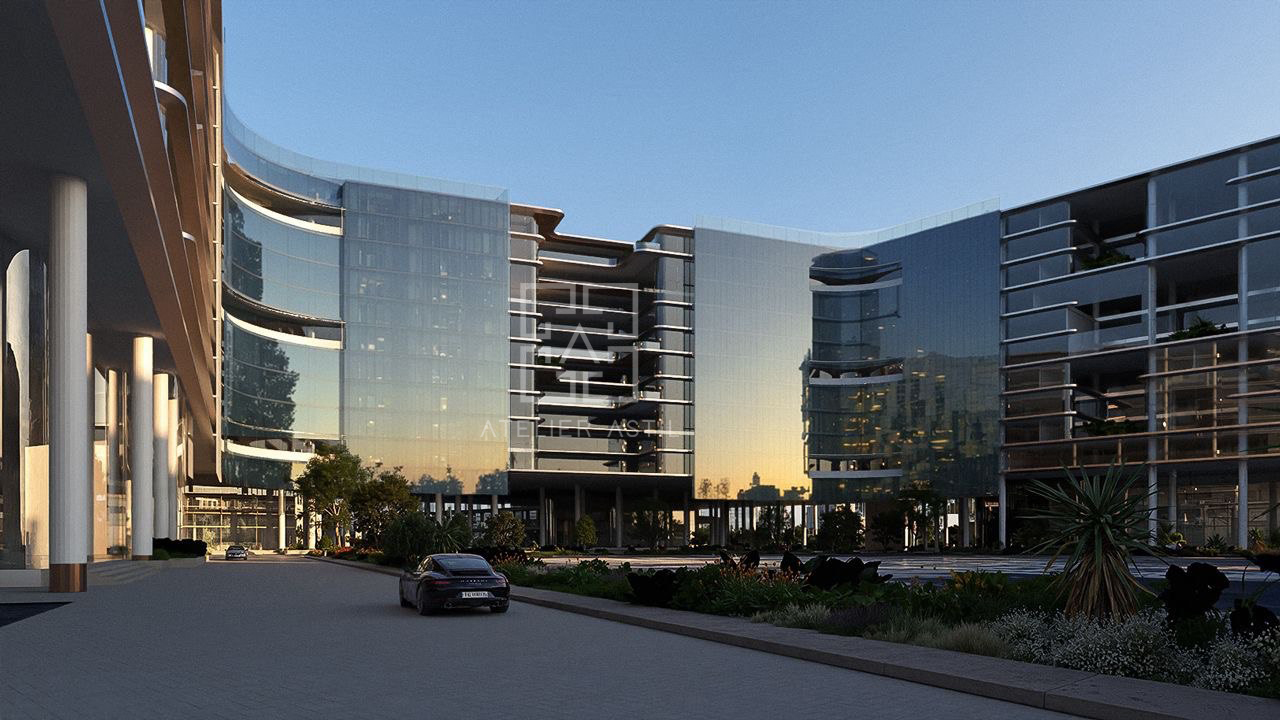
At 5.2 million square feet, architecture can no longer rely on form,it must operate as a system.
SOLARIS emerges within the commercial fabric of Bangalore as a calibrated response to scale, climate, and the evolving demands of contemporary workplace environments.
At this magnitude, the challenge is not simply one of construction, but of coherence,how to build at extreme density without collapsing into repetition, and how to sustain environmental performance within a typology that is typically sealed, energy,intensive, and spatially monotonous. The project addresses this through a deliberate rethinking of massing, where the built form is not treated as a singular volume, but as an articulated system of horizontal strata, vertical voids, and calibrated recesses that collectively mediate scale.
Height, in this context, is not an assertion of verticality but an instrument of performance. The building engages its vertical dimension to distribute light, air, and occupation across multiple levels, allowing the mass to operate as a layered environment rather than a stacked volume. Terraces, sectional shifts, and void insertions break the continuity of the façade, reducing perceptual bulk while introducing spatial variation within the workplace.
The envelope operates as the primary climatic device. In Bangalore’s tropical savanna condition, where solar radiation remains intense across extended periods, the façade is conceived as a depth,driven system rather than a planar surface. Continuous horizontal projections, extended slab edges, and curved fins intercept high,angle sun, while recessed glazing and vertical modulation respond to low,angle east and west exposure. The result is a layered interface that negotiates light and heat before they enter the interior, reducing thermal load while maintaining visual openness.
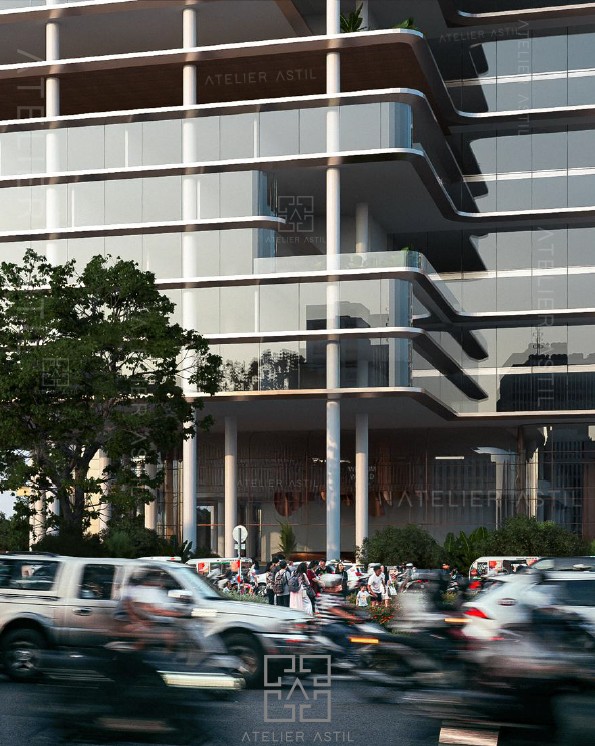
This approach is critical within the context of IT workspaces, where large floor plates, high occupant densities, and continuous operational cycles demand stable thermal and visual conditions. By controlling solar ingress and diffusing daylight through depth rather than surface treatment, the architecture reduces dependence on mechanical cooling systems while ensuring a
glare,free working environment. Environmental performance is embedded within form itself,emerging as a consequence of architectural decisions rather than applied technology.
At the scale of occupation, the project resists the monotony typically associated with large commercial developments. The introduction of terraces, voids, and spatial interruptions allows the workplace to extend beyond enclosed interiors, creating moments of pause, interaction, and release. These are not incidental insertions, but integral to the massing strategy,ensuring that even within a development of this scale, the experience remains legible and varied.
The central court anchors this system, acting as both spatial and organizational core. It introduces a controlled void within the density, allowing light to penetrate deeper into the plan while establishing a shared reference point across levels. The surrounding volumes do not simply enclose this space; they frame and amplify it, constructing an internal landscape that balances openness with containment.
Material expression is defined by restraint and precision. The architecture derives its identity not from applied finishes, but from the alignment of structure, envelope, and proportion. Repetition of horizontal bands, continuity of façade elements, and the controlled modulation of depth establish a coherent visual language,one that remains legible at both the urban scale and the scale of human occupation.
SOLARIS ultimately positions scale as a condition to be resolved rather than expressed. Through calibrated massing, a depth,driven façade system, and an integrated environmental strategy, the project transforms a large,scale commercial development into a responsive architectural system,one that performs, adapts, and sustains itself within the climatic and urban realities of Bangalore.
Sign-up to hear about our latest projects, news and events
